
At the close of his ministry, Jesus looks forward to his death on the cross, the open tomb and the ascension. Knowing that he is about to leave, Jesus prepares his disciples for what is to come. It is here that he makes clear what will be the
distinguishing mark of the Christian:
"My children, I will be with you only a little longer. You will look for me, and just as I told the Jews, so I tell you now: Where I am going, you cannot come. A new command I give you: Love one another. As I have loved you, so you must love one another. By this all men will know that you are my disciples, if you love one another." (John 13:33-35)
The first commandment is to love the Lord our God with all our heart, soul and mind. The second commandment bears the universal command to love men. Notice that the second commandment is not just to love Christians. It is far wider than this. We are to love our neighbor as ourselves.
I Thessalonians 3:12 carries the same double emphasis: "And the Lord make you to increase and abound in love one toward another, and toward all men, even as we do toward you." Here the order is reversed. First of all, we are to have love one toward another and then toward all men, but that does not change the double emphasis. Rather, it points up the delicate balance — a balance that is not in practice automatically maintained.
In I John 3:11 (written later than the gospel that bears his name) John says, "For this is the message that you heard from the beginning, that we should love one another." Years after Christ's death, John, in writing the epistle, calls us back to Christ's original command in John 13. Speaking to the church, John in effect says, "Don't forget this . . . Don't forget this. This command was given to us by Christ while he was still on the earth. This is to be your mark."
Sunday, August 26, 2012

Lament by Evangeline Paterson

Weep, weep for those
Who do the work of the Lord
With a high look
And a proud heart.
Their voice is lifted up
In the streets, and their cry is heard.
The bruised reed they break
By their great strength, and the smoking flax
They trample.
Weep not for the quenched
(For their God will hear their cry
And the Lord will come to save them)
But weep, weep for the quenchers
For when the Day of the Lord
Is come, and the vales sing
And the hills clap their hands
And the light shines
Then their eyes shall be opened
On a waste place,
Smouldering,
The smoke of the flax bitter
In their nostrils,
Their feet pierced
By broken reed-stems . . .
Wood, hay, and stubble,
And no grass springing.
And all the birds flown.
Weep, weep for those
Who have made a desert
In the name of the Lord.
Wednesday, August 22, 2012
The American Christian???
"(Today's Christian is) someone who has made the decision to be an emotionally well-adjusted, self-actualized risk-taking leader who knows his purpose, lives a no regret life of significance, has overcome his fears, enjoys a healthy marriage, is an attentive parent celebrating recovery from all their hurts, their habits, their hang-ups, and that practices biblical stress relief techniques, is financially free from consumer debt, fosters emotionally healthy relationships with his peers, attends a weekly life group, volunteers regularly at church, tithes off his gross, and has taken at least one humanitarian aid trip to a third world nation......Never once do you read in that modern contextualized interpretation that a Christian is one who sees their sin, confesses their sin, repents of their sin, and receives the gift of salvation in Christ alone. That's how far we've come. So Christianity now is dictated and defined by culture." Peter Murphy
Monday, August 20, 2012
G. K. Chesterton
Poverty is not the Problem
Sunday, August 19, 2012

Friday, August 17, 2012
The Loss of Shame
Our Narcissistic culture has diminished the use of shame as a motivator for people. Today, no one is expected to be ashamed of any behavior; what used to be considered shameful is now more often hailed as a source of self-esteem. Examples are too numerous to mention, but a recent one stands out: Once upon a time behavior such as Charlie Sheen has exhibited would be considered so shameful as to warrant secrecy. Now it is big business. Perry R. Branson, M.D.
The above quote came from the atheistic magazine Psychology Today; it is interesting that Branson finds the concept of shame to be a major pillar of human civilization and he fears that without it and its necessary relation to some form of religion, that our culture is in danger of complete collapse.
The state of the American culture (what's left of it) is in desperate need of a type of shame that is based upon Truth (Christ), not on some form of psychological abstract necessity as presented by Branson. I will give the man credit for understanding the need for morality but he is lost in the maelstrom of diversity and can provide no answers to a dying human race. MR
The above quote came from the atheistic magazine Psychology Today; it is interesting that Branson finds the concept of shame to be a major pillar of human civilization and he fears that without it and its necessary relation to some form of religion, that our culture is in danger of complete collapse.
The state of the American culture (what's left of it) is in desperate need of a type of shame that is based upon Truth (Christ), not on some form of psychological abstract necessity as presented by Branson. I will give the man credit for understanding the need for morality but he is lost in the maelstrom of diversity and can provide no answers to a dying human race. MR
Thursday, August 16, 2012
Daniel Defoe
“It put me upon reflecting how little repining there would be among mankind at any condition of life, if people would rather compare their condition with those that were worse, in order to be thankful, than be always comparing them with those which are better, to assist their murmurings and complaining.”
“I have since often observed, how incongruous and irrational the common temper of mankind is, especially of youth ... that they are not ashamed to sin, and yet are ashamed to repent; not ashamed of the action for which they ought justly to be esteemed fools, but are ashamed of the returning, which only can make them be esteemed wise men.”
Bad as he is, the Devil may be abused,
Be falsely charged, and causelessly accused;
When men, unwilling to be blamed alone,
Shift off the crimes on him, which are their own.
“I have since often observed, how incongruous and irrational the common temper of mankind is, especially of youth ... that they are not ashamed to sin, and yet are ashamed to repent; not ashamed of the action for which they ought justly to be esteemed fools, but are ashamed of the returning, which only can make them be esteemed wise men.”
Bad as he is, the Devil may be abused,
Be falsely charged, and causelessly accused;
When men, unwilling to be blamed alone,
Shift off the crimes on him, which are their own.

Wednesday, August 8, 2012
Marshall McLuhan
Ads are the cave art of the twentieth century.
Advertising is the greatest art form of the 20th century.
Art at its most significant is a Distant Early Warning System that can always be relied on to tell the old culture what is beginning to happen to it.
Art is anything you can get away with.
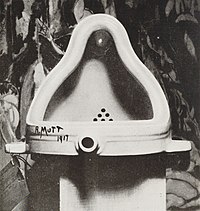
Advertising is the greatest art form of the 20th century.
Art at its most significant is a Distant Early Warning System that can always be relied on to tell the old culture what is beginning to happen to it.
Art is anything you can get away with.
Subscribe to:
Posts (Atom)


_-_The_Shepherdess_(1889).jpg)